WORD GAMES
25 word games for adults—from loud clues to quiet puzzles.
Word game can mean a one-minute team clue, a strategic connection puzzle or a playful story built around a table. This guide sorts formats by the language action they require so adults can choose the right balance of speed, knowledge, creativity and social pressure.
IN THIS ARTICLE
QUICK ANSWER
Start with the useful version.
For an energetic adult group, try Alias, forbidden words, charades with verbal clues or a category sprint. For no equipment, use word association, twenty questions, alphabet categories or fortunately/unfortunately. For quieter play, choose connection grids, duplicate clues, hidden definitions or a collaborative crossword. Match difficulty to shared knowledge, rotate the active role and define whether spelling, rhymes, gestures or translations are allowed before the first round.
CHOOSE THE LANGUAGE ACTION
A word-game list is useful only when the formats feel different.
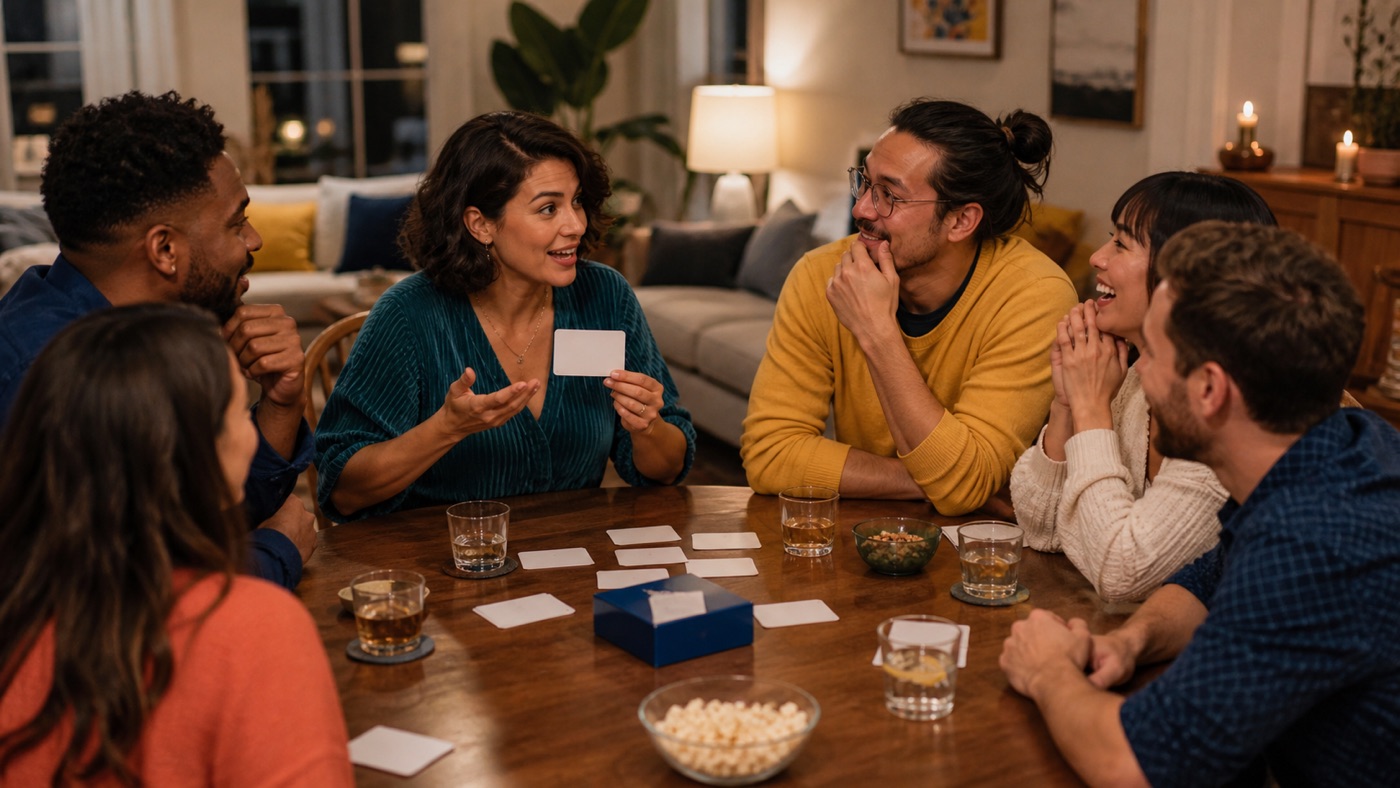
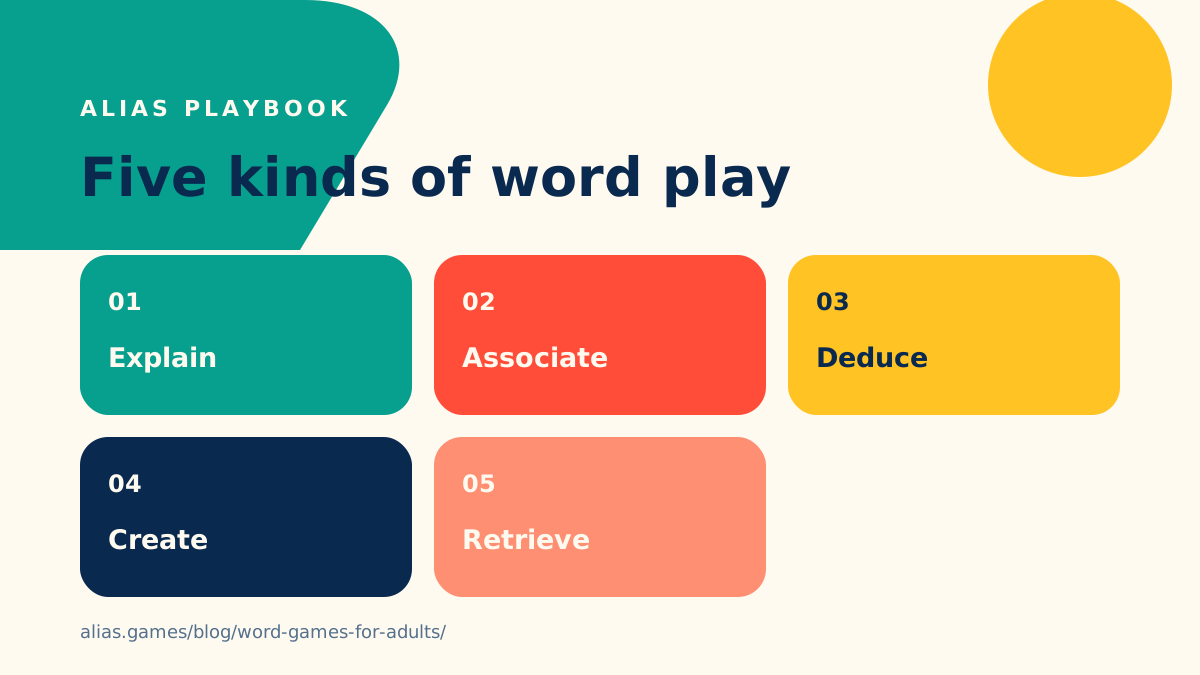
Start by asking what players should do with language. Explanation games turn a known concept into new phrasing. Association games connect ideas quickly. Deduction games narrow possibilities through questions or patterns. Creative games produce stories, definitions or captions. Retrieval games search memory under a category or letter constraint. Two games with the same theme can feel completely different when their language action changes.
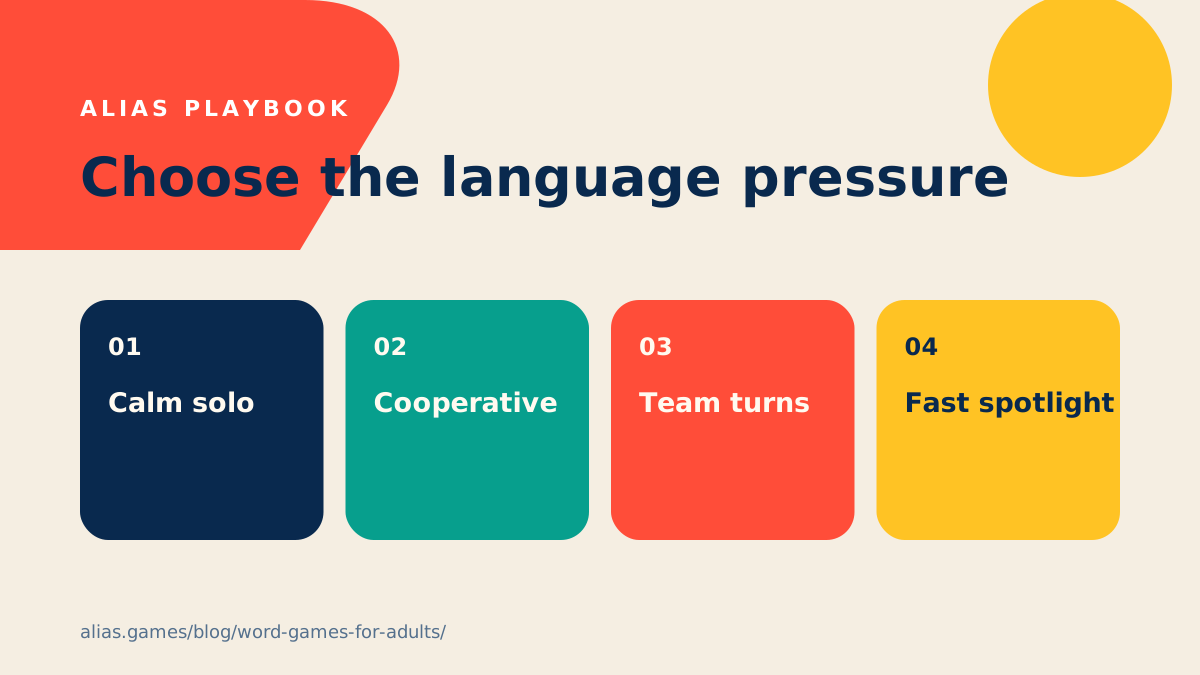
Then choose the pressure. A timed explainer has individual spotlight, while a cooperative connection grid lets the group deliberate. Difficult vocabulary is not automatically more adult; shared references and interesting constraints create better play than obscure words. Begin with a familiar category, learn the loop and increase complexity only when the room wants it. That keeps challenge separate from exclusion.
- Explanation.
- Association.
- Deduction.
- Creation.
- Retrieval.
EXPLANATION GAMES
1–5: say everything except the answer.
1. Alias: explain target words to a team without saying the word or its root. 2. Forbidden Words: add several obvious clues that cannot be spoken. 3. One-Sentence Clue: communicate the answer with one grammatical sentence and no follow-up. 4. Examples Only: explain through situations without a direct definition. 5. Reverse Definition: the group hears a deliberately vague definition and improves it one detail at a time until someone guesses.
Agree on compound words, translations, gestures, rhymes and spelling before play. Strong explainers name a category, add a concrete function and change route after unhelpful guesses. Rotate the role so linguistic confidence does not become permanent control. Use neutral everyday concepts for mixed-language adults and specialist packs only when knowledge is genuinely shared. The fun comes from reframing, not from watching someone meet a word nobody else recognises.
- Alias.
- Forbidden Words.
- One-Sentence Clue.
- Examples Only.
- Reverse Definition.
ASSOCIATION GAMES
6–10: connect ideas, then explain why the connection works.
6. Word Association Circle: each response links to the previous word without repeats. 7. One Clue, Three Words: connect several visible targets with one clue. 8. Odd Connection: teams receive two unrelated words and invent the clearest bridge. 9. Association Ladder: reach a target word from a starting word in five justified steps. 10. Same Association: pairs respond privately to a prompt and score a match.
Association rules should balance freedom and clarity. In a fast circle, accept a link unless it repeats or is obviously unrelated. In strategic formats, ask the player to state the bridge after the guess. Avoid disputes about whether one person’s cultural reference is sufficiently universal; the team either used the clue or it did not. Same Association works best with harmless prompts and does not need questions about relationships or personal history.
- Word Association Circle.
- One Clue, Three Words.
- Odd Connection.
- Association Ladder.
- Same Association.
DEDUCTION GAMES
11–15: narrow the word space with better questions.
11. Twenty Questions: identify a person, place or object through yes-or-no questions. 12. Hidden Rule: test words until the group discovers why some are accepted. 13. Mystery Category: reveal examples one at a time while teams name the category. 14. Missing Link: find one word that completes two phrases or connects two concepts. 15. Definition Bluff: players write plausible definitions for an unusual real word and try to identify the correct one.
Deduction games need an answer source the host can defend. Prepare the hidden rule and accepted examples, verify unusual-word definitions and give a hint before the group stalls. Definition Bluff should clearly mark invented text and reveal the source meaning at the end. Reward useful questions or reasoning, not only the final guess. A team that splits a broad possibility space in half has made a stronger move than one that randomly names ten objects.
- Twenty Questions.
- Hidden Rule.
- Mystery Category.
- Missing Link.
- Definition Bluff.
CREATIVE WORD GAMES
16–20: build language instead of finding a stored answer.
16. Fortunately/Unfortunately: alternate good and bad events in one story. 17. Six-Word Scene: describe a fictional moment using exactly six words. 18. Alphabet Conversation: each line begins with the next letter. 19. Caption Relay: everyone adds a caption to an ordinary image before anonymous reading. 20. Word Constraint Story: tell a short story that must include three random nouns without changing their forms.
Creative games work when the constraint is simple and judgment is light. Use a timer to prevent perfectionism and let people write in pairs. Do not score grammar, accent or artistic quality. A coherent result is satisfying, but a surprising turn is equally valid. If a prompt involves real people, replace it with a fictional character or object so humour stays focused on the constructed situation rather than someone in the room.
- Fortunately/Unfortunately.
- Six-Word Scene.
- Alphabet Conversation.
- Caption Relay.
- Word Constraint Story.
RETRIEVAL AND VOCABULARY
21–25: search memory with a fair, visible boundary.
21. Category Sprint: list unique examples under a timer. 22. Alphabet Categories: move through letters inside one topic. 23. Last Letter Chain: each word begins with the final letter of the previous word. 24. Synonym Ladder: replace a starting word with increasingly precise alternatives. 25. Collaborative Crossword: teams solve one grid together, explaining rather than merely announcing answers.
Retrieval speed varies with language, stress and familiarity, so use these as games rather than intelligence measures. Permit a pass, accept regional vocabulary and decide whether proper nouns count. For multilingual adults, extend the timer and choose a shared topic. In a collaborative crossword, ask confident solvers to explain a crossing or clue type so the grid remains a group activity instead of a silent demonstration by one expert.
- Category Sprint.
- Alphabet Categories.
- Last Letter Chain.
- Synonym Ladder.
- Collaborative Crossword.
MATCH THE GROUP
Change team structure before changing the game.
Two adults can alternate Alias rounds, solve a connection puzzle cooperatively or build a story with equal turns. Three to eight supports most explanation and deduction formats. For nine to twenty, create teams of three to five and run equal short rounds. Beyond twenty, use parallel tables or stations rather than one large circle. More players should create more teams, not longer waits.
For a remote call, send prompts privately and limit verbal groups to four or five so guesses remain audible. At a dinner table, choose seated formats and tolerate interruptions. During travel, use verbal games that do not require the driver’s attention. The same mechanic can work in many settings once turn order, prompt delivery and noise are designed for the actual group.
- Two: alternate or cooperate.
- Three to eight: direct play.
- Nine to twenty: small teams.
- Twenty-plus: parallel tables.
HOST A FAIR ROUND
Define the edge cases, then keep rulings short.
Before play, state the goal, time limit, turn order and legal clue boundary. Demonstrate one accepted and one rejected example. Choose a modest target score and run a practice round when the format is unfamiliar. Prepare broad categories for the opening and a second set of harder prompts only if everyone wants them. Do not confuse obscure vocabulary with a sophisticated adult game.
During play, make quick consistent rulings and protect rotation. If one player supplies every answer, shrink teams or require the active role to move. If a category excludes people, replace it. End while the rhythm is still good and offer a rematch before teaching another game. The strongest word-game night gives adults enough constraint to be inventive and enough freedom to enjoy one another’s thinking.
- Explain goal and boundary.
- Demonstrate one turn.
- Rotate active roles.
- Replace excluding categories.
- Offer a rematch before another rule set.
COMMON QUESTIONS
Clear answers before the next round.
What are good word games for adults?add
Alias, forbidden words, word association, twenty questions, hidden rule, definition bluff, category sprint and collaborative crosswords cover fast, social and strategic styles.
What adult word games need no equipment?add
Try word association, twenty questions, fortunately/unfortunately, alphabet conversation, category sprint, last-letter chains or a six-word scene.
What word games work for a group?add
Use explanation and category games in teams of three to five. For a large group, run parallel tables or stations to reduce waiting.
How do you make word games fair for multilingual adults?add
Use familiar categories, extend the timer, accept regional vocabulary, allow passing and avoid treating speed as language ability.
What rules should be agreed before a word guessing game?add
Clarify whether roots, translations, rhymes, gestures, spelling, proper nouns and skips are allowed, then demonstrate one legal clue.
KEEP EXPLORING
Rules and specialist guides.
READY FOR A ROUND?
Turn the advice into sixty seconds of play.
Download Alias, choose the setup that fits your room and start with one clear clue.

