START HERE
What is the Alias word game?
Alias turns one simple restriction—explain the word without saying it—into a fast team conversation. This complete introduction covers the core loop, the differences between card and app play, and the choices that make a first match work.

IN THIS ARTICLE
QUICK ANSWER
Start with the useful version.
Alias is a timed word-explanation game. One player sees a target word and describes its meaning, purpose, context, category, opposite or associations without saying the word or an agreed forbidden form. Teammates guess until the timer ends, then another team takes a turn. Correct answers score points. A physical edition uses cards, a board and a sand timer; the Alias app puts words, timing, teams and scoring on one phone.
THE CORE LOOP
One word creates a whole conversation.
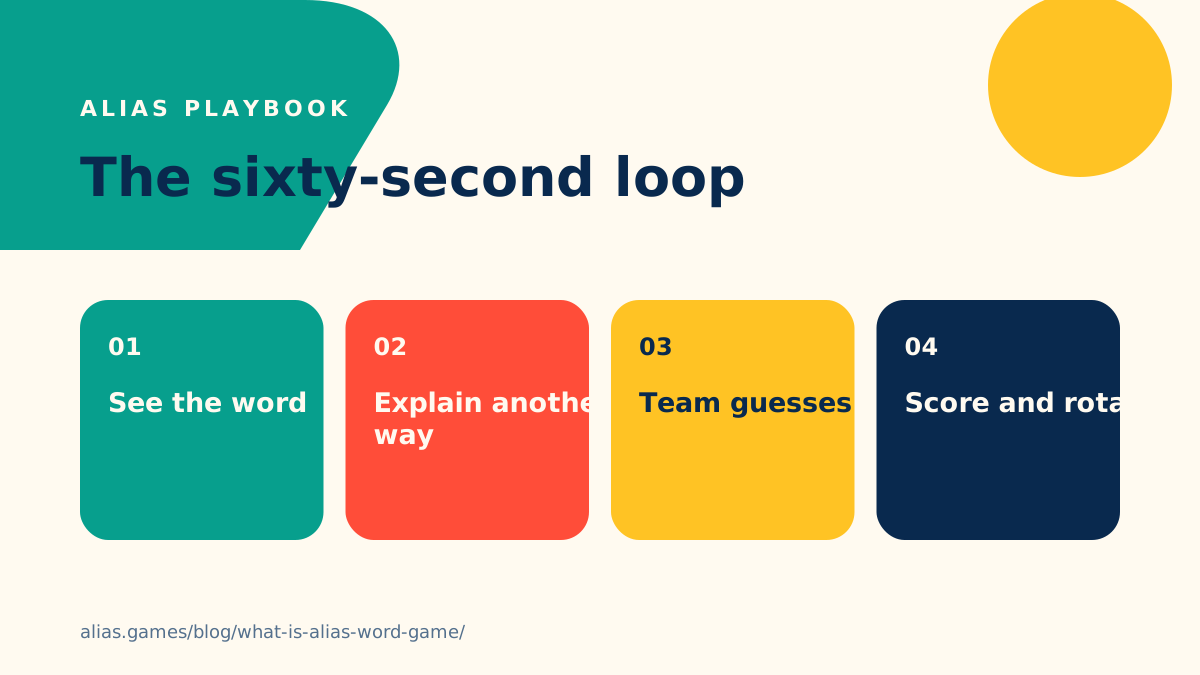
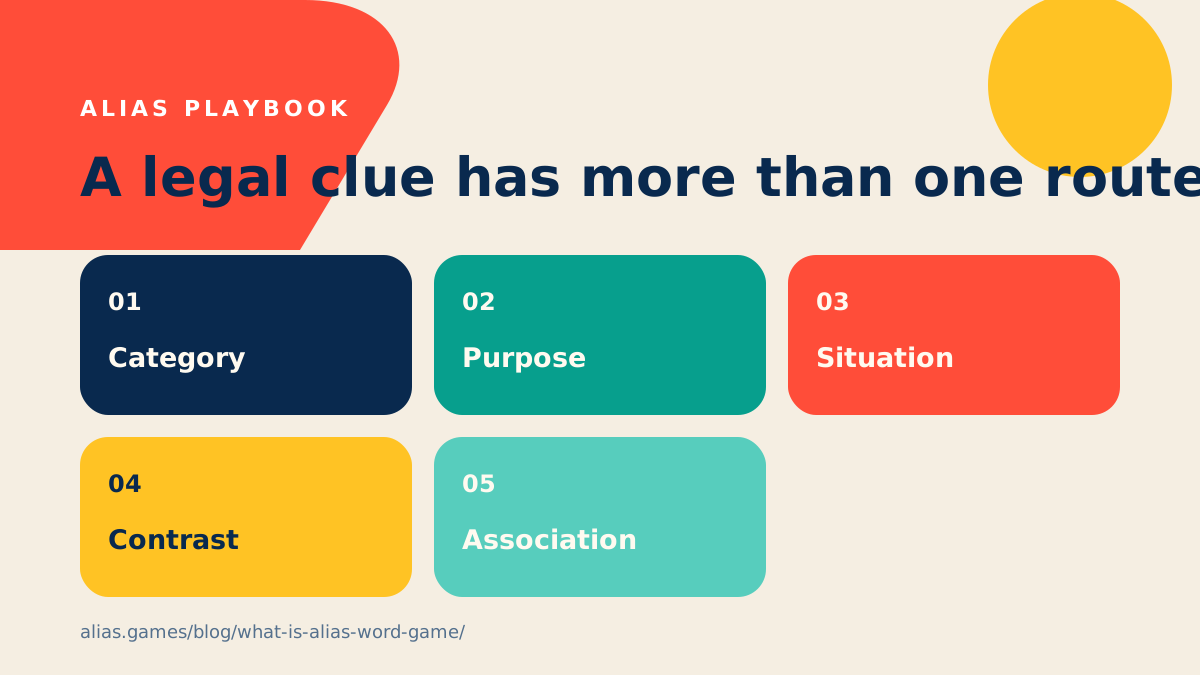
Every Alias turn begins with an information gap. The explainer can see a target word while the other players cannot. The explainer must build a bridge to that word with language: a definition, a situation, a function, an opposite, a comparison or a chain of associations. Teammates respond with guesses, and each guess gives the explainer new information about whether the clue is moving in the right direction.
The timer changes an ordinary vocabulary exercise into a party game. There is no time to compose a perfect dictionary definition, so players improvise, listen and change direction quickly. A clue for “umbrella” might begin with “something you hold above your head in rain.” If the team guesses “roof,” the explainer can add “portable” or “it folds.” That back-and-forth is the real engine of Alias.
- One player explains; teammates guess.
- Correct guesses add points.
- The role of explainer rotates.
- A short timer keeps every turn moving.
THE IMPORTANT RULE
Explain freely, but never give away the answer.
The essential boundary is easy to remember: do not say the target word. Most groups also forbid the word’s root, obvious grammatical forms and spelling clues. If the answer is “runner,” saying “a person who runs” removes the challenge because the root is already present. A cleaner clue would be “an athlete moving quickly on foot.” Before the first round, agree whether rhymes, gestures, translations and first-letter hints are allowed.
Good Alias play is generous rather than technical. The explainer should help the team find the concept, not search for a loophole. Name the broad category first, add one concrete detail and listen to the guesses. If a clue route fails, switch from definition to example or from example to contrast. Repeating the same sentence louder rarely helps, while a new angle can unlock the answer immediately.
- Use meanings, examples, contexts and opposites.
- Avoid the answer, its root and obvious derivatives.
- Agree on gestures, rhymes and translations before play.
- Change clue route when the team gets stuck.
TWO WAYS TO PLAY
Cards create the classic table; the app removes setup.
A physical Alias board game usually combines word cards, a path, playing pieces and a sand timer. Teams explain the numbered words that correspond to their position, count correct answers and move along the board. Different published editions may add special spaces, categories or penalties, so the rule sheet in the box remains the authority for that edition. The tactile board makes progress visible and suits a group that enjoys a longer tabletop match.
The mobile format keeps the same explain-and-guess idea but handles the practical work. The phone supplies words, counts down the round, records guessed and skipped cards, rotates teams and maintains the score. That makes Alias easy to start in a living room, classroom, train compartment or workplace without preparing a deck. Neither format changes the central skill: helping another person reach a hidden word under time pressure.
- Board: tactile progress and edition-specific rules.
- App: words, timer and scoring on one device.
- Both: team explanations under a time limit.
- Choose the format that creates the least friction for your room.
WHO CAN PLAY
Alias scales from a pair to a loud room.
The classic structure uses at least two teams, with one explainer and one or more guessers on each team. Four to eight people is especially easy to manage because turns return quickly and every team has enough voices. Larger groups work well when they are divided into several smaller teams rather than two enormous sides. Rotate the explainer every round so confident speakers do not control the entire match.
Two people can still play by alternating equal rounds and comparing scores, or by treating the session as a shared challenge. With three people, rotate one explainer and two guessers, then rebalance the totals after a complete cycle. Children, multilingual groups and mixed-age families benefit from familiar categories, a slightly longer timer and a no-penalty practice round. The best setup is the one that gives every person a real turn.
- Four to eight: straightforward team play.
- Two: alternating duel or shared challenge.
- Three: rotate roles across complete cycles.
- Large group: more small teams, shorter waiting time.
POINTS WITHOUT DRAMA
Decide the scoring edge cases before the timer starts.
A simple digital match awards one point for every correctly guessed word. Skipped words can be neutral or carry a penalty, depending on the setting your group chooses. A target score gives the match a clear finish. New groups should keep the system simple: correct equals one, unclear answers are judged by the host, and any disputed word is resolved quickly so the room does not spend longer debating than playing.
Physical editions may subtract points for skipped cards or illegal explanations, and some allow other teams to steal a final word. Those details create strategy, but they are not required for a lively app round. Explain the chosen rules in one minute, demonstrate one valid and one invalid clue, then play. A short practice round solves more confusion than a long pre-game lecture.
- Correct word: normally one point.
- Skip penalty: optional in the app.
- Target score: choose a reachable finish.
- Disputes: let one host rule quickly.
PICK THE RIGHT WORDS
Difficulty should match the room, not anyone’s ego.
Categories shape both fairness and mood. Familiar everyday objects create quick first rounds. Movies, science, finance, literature or pop culture reward shared knowledge and can produce sharper competition. A mixed group needs enough common ground that every player can contribute. If half the room does not recognise the references, difficult words do not make the game smarter; they simply reduce useful interaction.
Start with a broad or easy pack and raise the challenge after everyone has explained once. For children, use concrete nouns, visible actions and common places. For language learners, keep one topic per round and permit category prompts or sentence starters. For experienced friends, mix categories and reduce the timer. The goal is not to prove who knows the rarest word. It is to create clues that other people can actually use.
- First game: broad, familiar vocabulary.
- Children: concrete words and common actions.
- Classroom: one learning topic per round.
- Experienced group: mixed categories and faster timing.
WHY PEOPLE KEEP PLAYING
Alias rewards adaptation more than stored trivia.
A person can know a word perfectly and still struggle to explain it under pressure. Another player may find a vivid everyday example in two seconds. Alias rewards this ability to model what another person knows, notice misunderstandings and reframe a message. Guessers contribute just as much: strong teams listen for category, test hypotheses quickly and use earlier clues rather than shouting unrelated words.
That makes the game useful in many settings without turning it into a lesson. Families see how generations describe the same idea differently. Friends build shared references. Learners practise retrieval and paraphrasing. Colleagues get a low-stakes example of communication repair. The laughter usually comes from imperfect explanations, but those imperfect explanations are also where the most interesting thinking happens.
- Explainers practise paraphrasing.
- Guessers practise active listening.
- Teams learn one another’s associations.
- Fast recovery matters more than perfect definitions.
START TONIGHT
Your first match needs only a phone and five decisions.
Gather the players, make balanced teams and choose a category everyone can recognise. Set a 60-second round, choose a modest winning score, decide whether skips lose points and name the first explainer. Run one unscored practice turn. During that practice, show the group how to mark a correct or skipped word and what happens when the timer ends.
After the practice, begin the real match and keep the phone moving. Rotate explainers, protect the rhythm and save rule refinements for the break between rounds. If the room is enjoying the game, the scoring system is doing its job. If people are waiting too long or repeatedly meeting unfamiliar words, change team size or category. Alias is deliberately adjustable: the best rules make the people in front of you want one more round.
- Make teams.
- Choose a category.
- Set time and target score.
- Agree on skips and clue boundaries.
- Play one unscored practice turn.
COMMON QUESTIONS
Clear answers before the next round.
Is Alias a board game or an app?add
Alias exists as a physical word-explanation board game and as mobile apps that handle words, timing, teams and scoring. The central explain-and-guess mechanic is shared, while detailed rules vary by edition.
Can two people play Alias?add
Yes. Alternate equal explaining rounds and compare totals, or play cooperatively against a shared target. The dedicated two-player guide offers several fair formats.
Can you say part of the word in Alias?add
Normally no. Most groups forbid the answer, its root and obvious derivatives. Agree on edge cases such as compounds, translations, rhymes and gestures before the match.
How long is an Alias round?add
Sixty seconds is a clear starting point. Use longer turns for children or language learners and shorter turns for experienced groups that want more pressure.
KEEP EXPLORING
Rules and specialist guides.
READY FOR A ROUND?
Turn the advice into sixty seconds of play.
Download Alias, choose the setup that fits your room and start with one clear clue.

