LARGE GROUPS
20 large-group games that keep everyone playing.
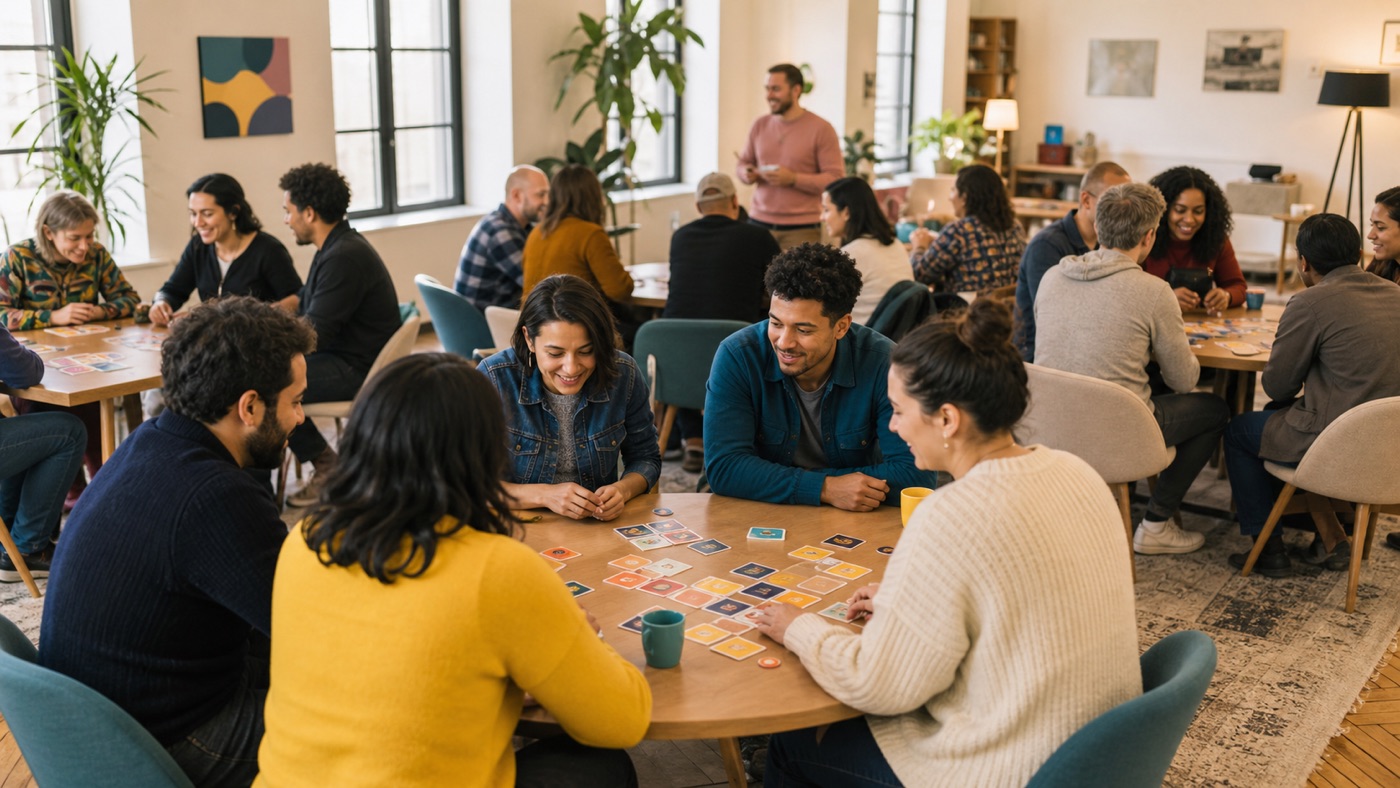
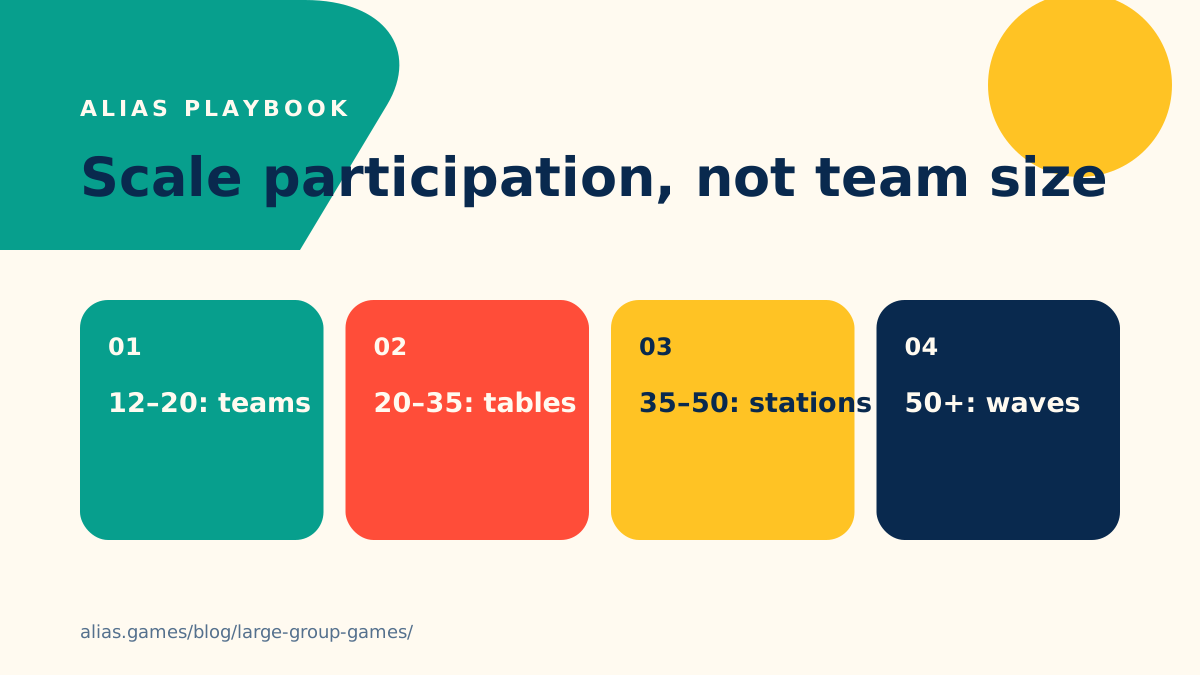
A game does not scale merely because more names fit on the team list. This guide focuses on participation rate, room layout, noise, accessibility and reset time so a host can turn twelve, twenty or fifty people into active small groups instead of one large audience.
IN THIS ARTICLE
QUICK ANSWER
Start with the useful version.
The best large-group games minimise waiting by using small teams, parallel stations or simultaneous answers. For 12–20 people, run Alias, charades or drawing relays in teams of three to five. For 20–50, use several identical stations, human-spectrum choices, scavenger grids or table tournaments. Keep rounds short, display the rotation, avoid public elimination and choose a final activity that brings the whole room together without requiring everyone to perform alone.
THE SCALE TEST
Count how many people act at once—not how many can technically join.
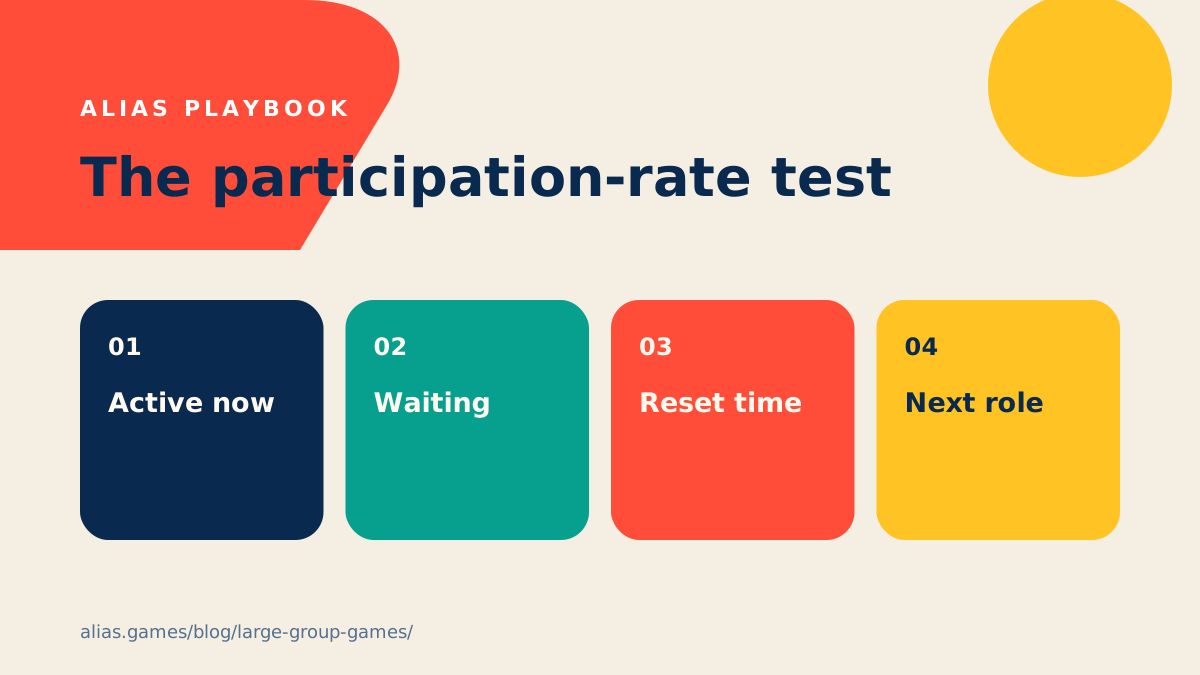
A twenty-person circle can be called one game, yet only one player may be speaking while nineteen wait. Participation rate is a more useful measure. Divide the number of people making a meaningful choice by the total group. A format with five teams answering simultaneously will usually feel faster than a single-file relay even when both take ten minutes on paper.
Also count reset time. If each turn requires rearranging chairs, explaining a new exception or finding a missing prop, the crowd will lose attention between moments of play. Choose activities with a repeatable loop and prepare the next player before the current timer ends. For a mixed group, make sure observing, timing or recording is an intentional role rather than the default fate of quieter participants.
- Measure active choices per minute.
- Prefer small teams to oversized teams.
- Keep the reset identical every round.
- Give waiting players a defined task.
FAST TEAM GAMES
1–5: short rounds create a lively room without complex logistics.
1. Multi-Team Alias: teams of three to five take equal timed turns explaining target words. 2. Parallel Charades: two or more teams act at the same time with different prompts. 3. Picture Relay: one player sees an image, describes it to a teammate, and the final player draws the result. 4. Soundtrack Guess: teams identify a scene, object or action from vocal sound effects only. 5. Category Sprint: each table writes as many unique examples as possible before the timer ends.
Use identical durations and broad categories, not identical random words, to create fair-enough conditions. Announce the rotation visually and begin each table together. If the room is noisy, written guesses or drawing may work better than louder verbal clues. Do not run a public dispute after every prompt. Let a table host make quick decisions and reserve only genuine rule questions for the central facilitator.
- Multi-Team Alias.
- Parallel Charades.
- Picture Relay.
- Soundtrack Guess.
- Category Sprint.
EVERYONE CHOOSES
6–9: simultaneous games produce almost no spectator time.
6. Human Spectrum: people position themselves along an imaginary line between two low-stakes preferences. 7. Four Corners: each corner represents an answer and everyone moves to a choice before a short discussion. 8. Same Answer Teams: small groups privately choose one response and reveal together. 9. Prediction Cards: every person predicts the room’s majority answer to a harmless question, then the host reveals the vote.
Simultaneous movement needs accessible alternatives. A person can hold a coloured card, point or remain seated while choosing. Keep preference prompts neutral—morning versus evening, city versus countryside, sweet versus savoury—and never interpret a position as a personality diagnosis. The brief conversation after each choice is more valuable than the distribution itself. Two or three prompts are enough; endless polling becomes repetitive even when everyone participates.
- Movement or seated choice.
- Neutral preferences.
- Private selection before reveal.
- Short discussion, then reset.
ROTATING STATIONS
10–13: stations turn one crowded event into several manageable rooms.
10. Word Station: a two-minute explain-and-guess round. 11. Build Station: construct the tallest freestanding paper structure with limited sheets. 12. Sort Station: arrange fictional events, images or objects according to a given rule. 13. Story Station: add one sentence to a shared narrative before moving on. Teams rotate every six to eight minutes and collect stamps, points or simply completed challenges.
A strong station can be understood from one printed instruction and reset in under a minute. Use the same duration at every station so movement remains predictable. Place noisy activities apart from quiet ones and provide wide routes between tables. Assign one facilitator only where safety or hidden information requires it; self-running stations reduce staffing. Test the entire rotation once with a colleague, including the transition, rather than testing each activity in isolation.
- One visible instruction.
- Equal station duration.
- Fast reset.
- Clear direction of movement.
- Separate noisy and quiet tasks.
NO EQUIPMENT
14–16: verbal structures rescue a large group when materials fail.
14. Team Twenty Questions: each table receives a secret concept and another table asks yes-or-no questions. 15. Alphabet Categories: teams fill one category from A onward, skipping letters by agreement. 16. Story Headlines: each group invents a headline for the same fictional event and the room votes for clearest, funniest or most surprising. These games require only a timer and, if available, scrap paper.
With no equipment, instructions must do more work. State the order of teams, the length of discussion and how answers are revealed. Avoid elimination because a large eliminated team becomes a large distraction. If the space has poor acoustics, let a representative bring the team’s final answer to the host instead of shouting across the room. The format should reduce noise rather than reward whichever table can be heard from furthest away.
- Team Twenty Questions.
- Alphabet Categories.
- Story Headlines.
- No public elimination.
LOWER THE VOLUME
17–18: quiet games still create a shared experience.
17. Gallery Guess: teams create a simple drawing or six-word description, display it anonymously and walk through the room to guess each prompt. 18. Silent Sequence: each team arranges illustrated cards into a plausible story without talking, then explains the result after the timer. Both formats distribute attention across the space and help when continuous shouting would exclude participants or overwhelm the venue.
Quiet does not mean passive. Give every participant a marker, card-handling role or section of the gallery to review. Set a clear path around displays and avoid placing content too high or too close together. Anonymous outputs should remain respectful; the host removes anything targeting a person or group. A short shared reveal at the end lets the entire room laugh at patterns without requiring every team to deliver a long presentation.
- Gallery Guess.
- Silent Sequence.
- A role for each player.
- One compact shared reveal.
BRING THE ROOM TOGETHER
19–20: finish with a shared challenge, not a long awards ceremony.
19. Champion Clue: each table selects one explainer for a final Alias word while all teammates guess; the simultaneous round lasts sixty seconds. 20. Mosaic Reveal: every team contributes one phrase, drawing or object arrangement to a larger fictional poster or story that the host reveals. A finale should make the room feel connected without erasing the small-group structure that kept participation high.
Keep scoring transparent but light. If stations used different tasks, do not pretend their points are perfectly comparable. Celebrate multiple outcomes such as clearest teamwork, most inventive solution or strongest recovery, provided these labels remain about observable work rather than personality. End on time. A five-minute finale followed by a clear close preserves energy better than reading every score and retelling every round.
- Champion Clue.
- Mosaic Reveal.
- Observable celebrations.
- Five-minute maximum.
FACILITATOR CHECKLIST
Design movement, access and recovery before guests arrive.
Map the room, exits, seating and sound. Decide where each team begins and how it knows where to go next. Prepare one more copy of every instruction than you expect to need. Test the timer, prompts and reset materials. Name a central help point, but allow table hosts to resolve ordinary ambiguity. If technology is involved, prepare a version that can continue with paper or speech.
Brief the group in three layers: the purpose, the repeated round loop and the finish. Demonstrate a single example, then start. Watch waiting time, not just excitement near the loudest table. Shorten a station that creates a queue, open a second copy of a popular task or skip a broken activity entirely. Good large-group facilitation is active editing: protect access and momentum even when the original plan needs to change.
- Map the room and routes.
- Duplicate instructions.
- Demonstrate one loop.
- Watch queues and waiting.
- Keep a low-tech recovery path.
COMMON QUESTIONS
Clear answers before the next round.
What games work for a large group of adults?add
Use parallel Alias or charades, category sprints, four corners, rotating stations, gallery games or a short multi-team tournament. Small teams keep participation high.
How many people should be on a team in a large group game?add
Three to five is a useful default for verbal and creative tasks. Increase only when every additional player has a clear active role.
What large-group games can be played indoors?add
Word stations, picture relays, category sprints, same-answer teams, hidden-rule puzzles, silent sequencing and gallery guessing all adapt to indoor venues.
How do you avoid long waiting in large-group games?add
Use simultaneous answers, parallel tables or stations; prepare the next player early; keep resets short; and remove public elimination.
Can large-group games be accessible?add
Yes. Offer seated equivalents to movement, visual and spoken instructions, alternative roles, clear routes and no-penalty passing.
KEEP EXPLORING
Rules and specialist guides.
READY FOR A ROUND?
Turn the advice into sixty seconds of play.
Download Alias, choose the setup that fits your room and start with one clear clue.

